A trading card studio a kid can run alone.
My kid describes a creature in their own words. Claude writes the whole card, OpenAI draws the art, and every version is saved, ready to print.
A 7-year-old makes a finished, printable card, and evolves it into a three-stage series, on their own.
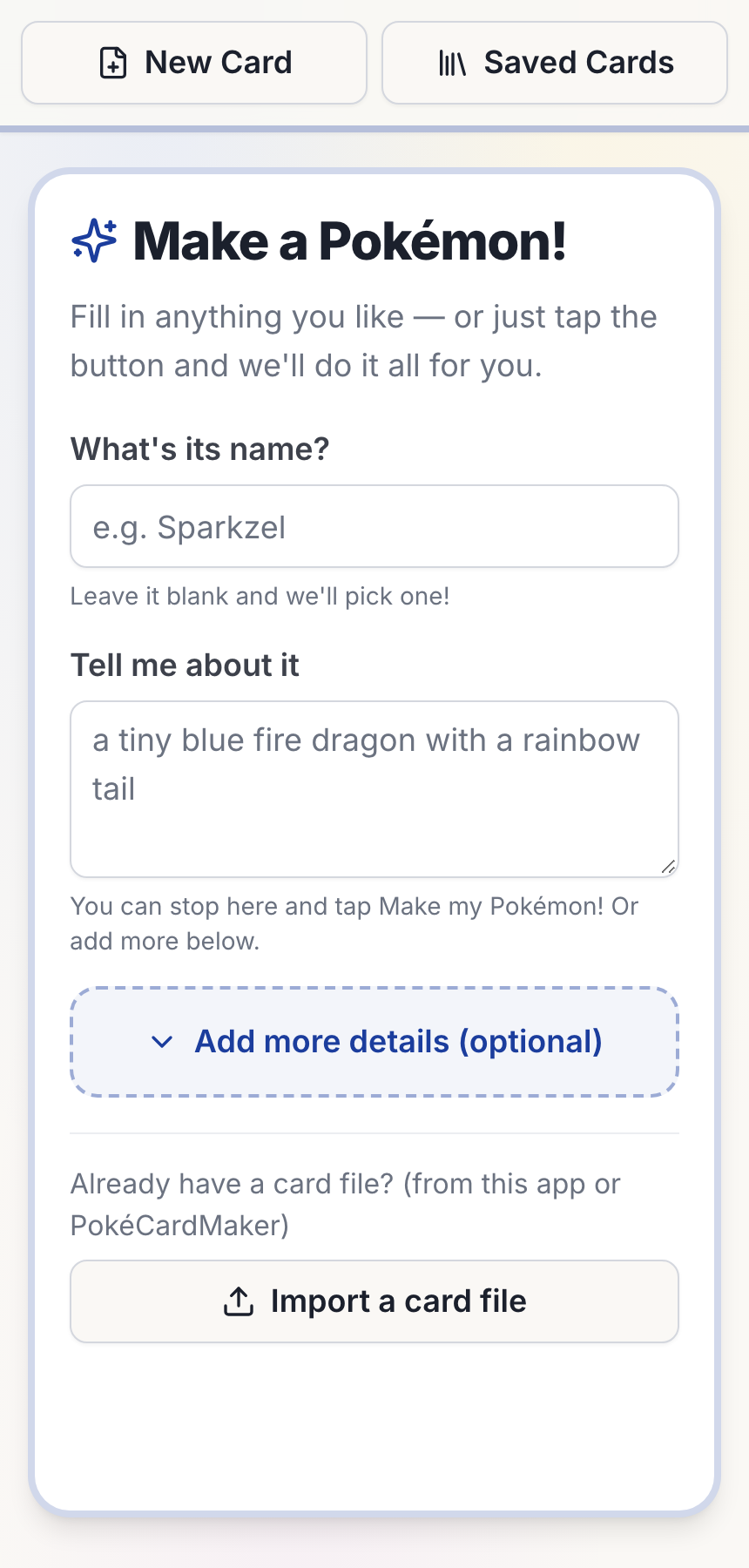
Describe it. AI fills the card.
Claude fills every field
Type a name or a sentence. Claude writes the stats, moves, weakness and flavor text. Any single field or move can be rewritten with one tap.
AI artwork
OpenAI draws the picture. “Make my picture wide” stretches it to fit the card and retries once if the safety filter blocks it.
Saved and printable
Every save keeps the older versions. Export produces the exact file a card-printing site accepts.
Series, not single cards.
Basic → Stage 1 → Stage 2
One tap evolves a creature to its next stage, or back to its earlier form, so a kid builds a whole evolution line.
Same creature, grown up
OpenAI draws each new stage from the earlier card's picture, so the creature keeps its look as it grows.
Stats that fit the stage
Claude follows stage rules: HP, attack damage and the “evolves from” name scale with each stage, like a real set.
Built for the person using it.
- Every word on screen is short and kind, written for a child. Errors say what to do next, never what broke inside.
- Big tap targets, because the main user is 7.
- When OpenAI retired the image model on October 23, 2026, I had it fixed within a week and made the model a single setting, so the next change takes minutes.
What this looks like for your customers.
The same approach works for a business: find the part people avoid, let AI do it, and make it simple enough to use the first time.
- A form customers fill in a sentence, with AI completing the rest.
- AI images on brand, with retries when a filter trips.
- Every version saved, so nothing anyone makes is lost.
Your first step
Tell me the form or task your customers or staff avoid. I'll tell you what an AI version would look like.
Book a call →adam@adamwayne.com